
How to Search Cases by Name
For an adult Municipal Court matter, open Authority Web Connect. Accept the notice that appears. Then pick TR/CR Case Lookup or Civil Case Lookup. The Traffic/Criminal form posts its own name instructions. The Civil form works through party-role choices. Common Pleas CourtView puts a CAPTCHA in front of its public-record search action, so its name-search fields stay behind that gate. The Municipal field rules do not carry over. Treat each portal as its own system.
- Choose the court first: Municipal for countywide adult traffic, adult misdemeanor, and limited civil cases; Common Pleas for felony and major civil cases.
- For an adult Municipal criminal or traffic name search, select Name and enter the name in the portal's stated format.
- For a Municipal civil search, select Plaintiff or Defendant and enter the last name or business name matching that role.
- For Common Pleas, complete the displayed CAPTCHA, then use only the fields actually offered by the Clerk portal.
- When a result is unclear or absent, call the office that owns the court record rather than guessing from another system.
The Municipal Criminal and Traffic rule is precise. Enter last name, then first name, with a comma between them, like Smith,Jonathan. You can also use the last name alone. The space after the comma is optional. That one punctuation detail can be the difference between a hit and a failed query in the Knox County court docket.
Knox County Case Lookup Routing
Routing comes before any docket search. Mount Vernon Municipal Court holds countywide jurisdiction over adult misdemeanors and traffic. It also covers felony initial and preliminary hearings, civil matters up to $15,000, small claims up to $6,000, evictions, and BMV appeals. The Court of Common Pleas General Division takes felony prosecutions. It also takes civil matters over $15,000. Domestic Relations, Probate, and Juvenile each run their own divisions and record practices. Match the case to the court first. The rest of the Knox County case lookup follows from that choice.
| Knox County case type | Primary lookup path | Owning-office fallback |
|---|---|---|
| Adult traffic or misdemeanor | Municipal Authority Web Connect TR/CR Case Lookup | Mount Vernon Municipal Court, 740-393-9510 |
| Felony or major civil case | Common Pleas CourtView public-records portal after CAPTCHA | Knox County Clerk of Courts, 740-393-6788 |
| Probate matter | Probate CaseLook | Probate Court, 740-393-6798 |
| Juvenile matter | Court-specific access, subject to confidentiality | Probate/Juvenile Court |
A felony can start in Municipal Court as a preliminary phase. It then moves on to Common Pleas. Searching only one system risks missing a later stage of the same Knox County case.
Knox County Name Search Fields
The Municipal portal offers two lookup forms with different field inventories. TR/CR Case Lookup gives six ways to choose a search. Civil Case Lookup gives three. Neither form demands a login for basic lookup, though the visitor must accept the portal disclaimer first. What the forms describe are search controls rather than a result format. So plan the query around the controls themselves.
| TR/CR field or method | Type | Knox County format note |
|---|---|---|
| Lookup Case By | Dropdown | Name, Soundex, Case, DOB, Ticket, or Plate # |
| Name | Conditional method | Last,First or last name; a comma is required when both names are used. |
| Soundex | Conditional method | Last name or last name,first name; the portal warns the search can take longer. |
| Case | Conditional method | Two-digit year, case type, and number. |
| DOB, Ticket, Plate # | Conditional methods | DOB uses MM/DD/YYYY; the others use their matching identifiers. |
The Civil Case Lookup menu is narrower. Choose Plaintiff, Defendant, or Case. Plaintiff and Defendant take a last name or business name; Case takes a case number. The form states no formal required field, no civil case-number sample, no status or date filter, and no export option.
| Civil lookup method | Entry supplied by the portal |
|---|---|
| Plaintiff | Last name or business name of the plaintiff only |
| Defendant | Last name or business name of the defendant only |
| Case | Case Number |
How to Search by Case Number
A complete case number usually beats a broad name search in Knox County. The Municipal TR/CR portal documents the general form as a two-digit year, a case type, and a number. Its example is 12TRC12345. That code hints at the local Municipal pattern. It does not prove every historic, civil, or Common Pleas case follows the same series.
Common Pleas formats stay behind the CourtView CAPTCHA. The Municipal Civil form asks for a case number but posts no sample. Copy the number exactly from a court notice, citation, filing, or prior court communication. Then use the portal for that court. Never reshape a number to mimic the TR/CR example.
Keep schedule queries separate from case lookup in Authority Web Connect. A known number finds the case record. But the current court date needs the matching TR/CR or Civil Schedule Query. When doubt remains, confirm with the court.
Knox County CourtView CAPTCHA
The Clerk's service goes by a long name. It is the Knox County Common Pleas Public Records Search and E-Filing Portal. The entry page offers Home, eFile, Log on, and a print icon. Before you can reach the public-record search, a CAPTCHA asks you to type letters shown in an image. That step guards the system. So plan for it when you sit down to run a docket search.
Past the CAPTCHA sits a set of search controls. They are the kind every court docket tool uses: name, case number, party role, date, result, and document fields. The portal also posts its own fine print. Case information, it says, comes from computerized Clerk records. It is deemed public information and carries no warranty. Filers are told to strip metadata from their documents, since anything left behind may become public record. Those notices are worth heeding. A portal result is not the same as the court file itself. Neither replaces a certified copy from the Clerk.
The Ohio general-docket statute sets out the recordkeeping duties that sit behind these court records.
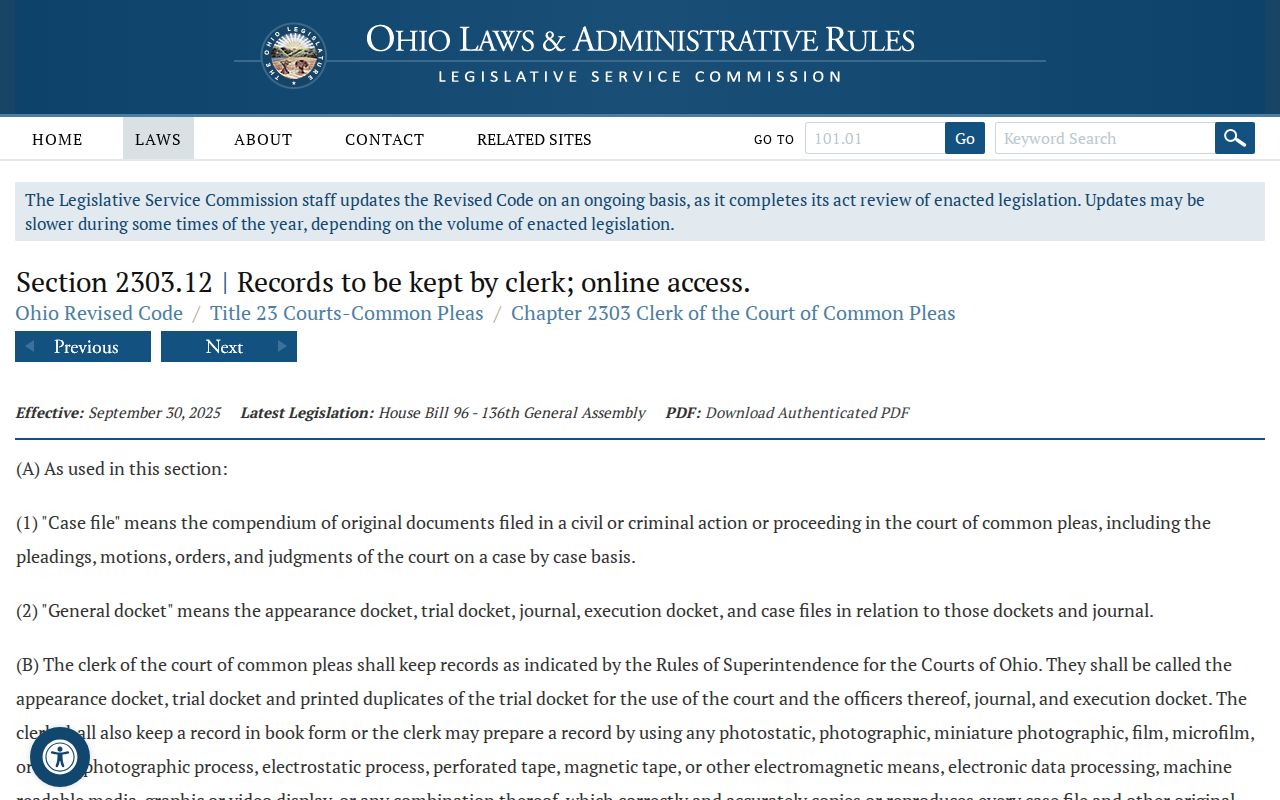
R.C. 2303.12 governs Common Pleas general-docket and case-file recordkeeping and allows qualified online availability. It carves out restricted records plus specified domestic-relations and juvenile exceptions.
What a Case Search Shows
A case search finds records. It does not promise one uniform display. Expect terms like case information, case record, case number, case type, setting, motion, order, judgment, and disposition. No result screen is guaranteed to show the same headings, a party list, a filed date, a status, a financial field, a document link, or a redaction label. The safe habit is simple. Use a result to identify the court and the case, then verify the exact item with the record keeper that holds it.
| Case information | The public summary or search layer named by local portals; it is not a certified record. |
|---|---|
| Case number | The court identifier used to return to the correct record and ask the clerk for a copy. |
| Case file | Pleadings, motions, orders, and judgments collected for one action under the Common Pleas statutory definition. |
| Setting | A notice that an event has been assigned a date and time; the separate schedule query may be needed. |
| Disposition | The recorded resolution or outcome, without a claim about a universal local display label. |
Need a certified copy, or a case too old or unclear to read online? Call the office that owns it. The Clerk of Courts Common Pleas counter sits at 117 East High Street, Suite 201, Mount Vernon. The office lists 740-393-6788 along with clerkofcourts@knoxcounty.oh.gov. Municipal Court and Probate/Juvenile each keep their own dockets. So direct your request to the right court.
Knox County Probate Search Lag
Probate CaseLook works as its own acceptance-screen search. It stands apart from CourtView and the Municipal Civil Lookup. Expect some lag. The Court warns that new filings and judicial actions can take at least 24 hours to appear, and sometimes longer, because retrieved computer information is current only within the system's own limits. When you need verified probate information, the Court's stated options are to send a request or visit during regular business hours. That docket search stands on its own.
The Knox Probate CaseLook entry shows the portal itself. It includes the agreement stage and search terms.
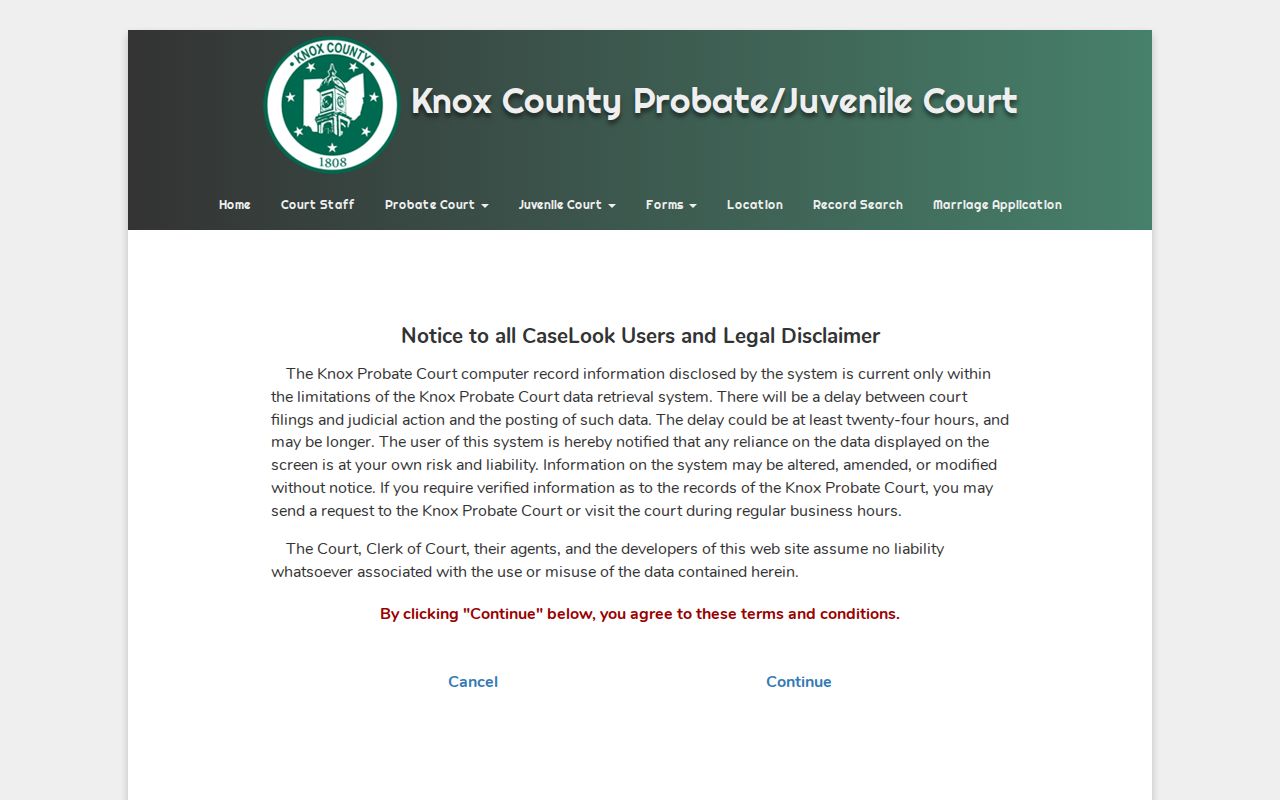
The portal opens with an agreement screen you must accept before searching. Fees for copies or downloads, if any, appear on the court's own pages rather than in the docket results.
Juvenile records carry extra confidentiality rules. Local rules treat psychological reports, social histories, guardian ad litem reports, home studies, and juvenile probation records as confidential or restricted. If a juvenile case lookup comes up empty, that closed door is not an invitation to hunt the same file through another portal.
County vs Statewide Case Search
Ohio has no public statewide docket search that covers county cases from one place. The Ohio Courts Network is a data-exchange project linking connected courts, not a substitute for the court-specific portals Knox County already provides. So start your case lookup with the local court that owns the matter. Any site claiming to offer statewide comparison results is not the official route.
| Local court-specific system | What it serves | Limit documented in research |
|---|---|---|
| Common Pleas CourtView | General and Domestic Relations public-records and e-filing entry | CAPTCHA-gated; post-CAPTCHA fields were not inspected |
| Authority Web Connect | Countywide Municipal TR/CR and civil lookup, plus separate schedule queries | Portal result inventory was not retained or transcribed |
| Probate CaseLook | Probate record-search entry | Posting may lag at least 24 hours; verified information needs court request or visit |
Compare like with like: court-specific systems, not a county portal against some statewide Ohio results page that does not exist. Don't know which court holds the record? Begin with the subject and case type, then ask the Clerk or the Court which Knox County division owns the file.
Restricted Cases and Access Rules
Ohio law starts from the idea that court records are open. That presumption bends, though. Statutes, court rules, redactions, and judicial orders can all limit what a Knox County court docket shows the public.
The traditional framework for this is Sup.R. 44 through 47, which governs public access to court records across Ohio. One caution: the Supreme Court has restructured some of that rule numbering effective July 2026. So the citation you see may shift. R.C. 149.43, the state's Public Records Act, opens access to public offices generally. Yet court cases answer to their own judicial rules on top of it.
Restricted-record point: Sealed or expunged adult records, juvenile confidentiality categories, personal identifiers, and some domestic-relations information can limit online access.
R.C. 2953.32 provides the statutory route for eligible sealing or expungement applications, subject to qualifications and exceptions.
A docket search that comes back empty has many possible causes. The case may be newly filed, or the clerk's posting may lag. A misspelled name or a wrong case number will do it too. So will searching the wrong division or a record under restriction. Check that you searched the right court first. Then ask the office that holds the record whether lawful access exists. One blank screen never proves a case history is complete.
Knox County Federal Case Boundary
Federal matters live outside the Knox County Clerk, Municipal Court, and Probate systems entirely. A federal case will not surface in a county docket search. Knox County sits in the U.S. District Court for the Southern District of Ohio, Eastern Division at Columbus.
Public federal docket access runs through PACER, and that requires registration. It is the wrong tool for a Knox County Common Pleas or Municipal case lookup. Use it only for federal filings. For the state side, the Ohio Rules of Court landing page lays out the full set of state court rules.
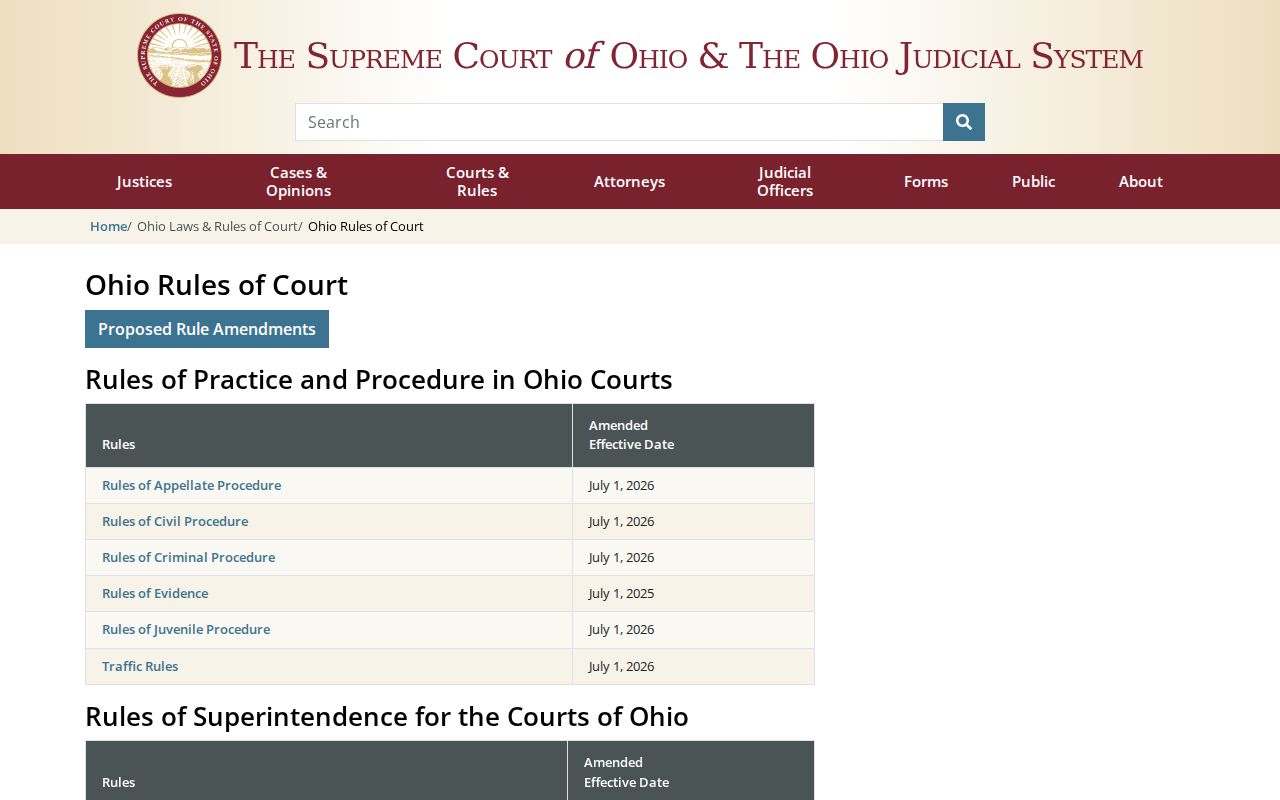
State court rules shape local access, while federal cases move through their own courts and PACER. For bankruptcy filings in this region, the Southern District of Ohio Bankruptcy Court Columbus page posts court information and docket resources for the Columbus seat of the court.
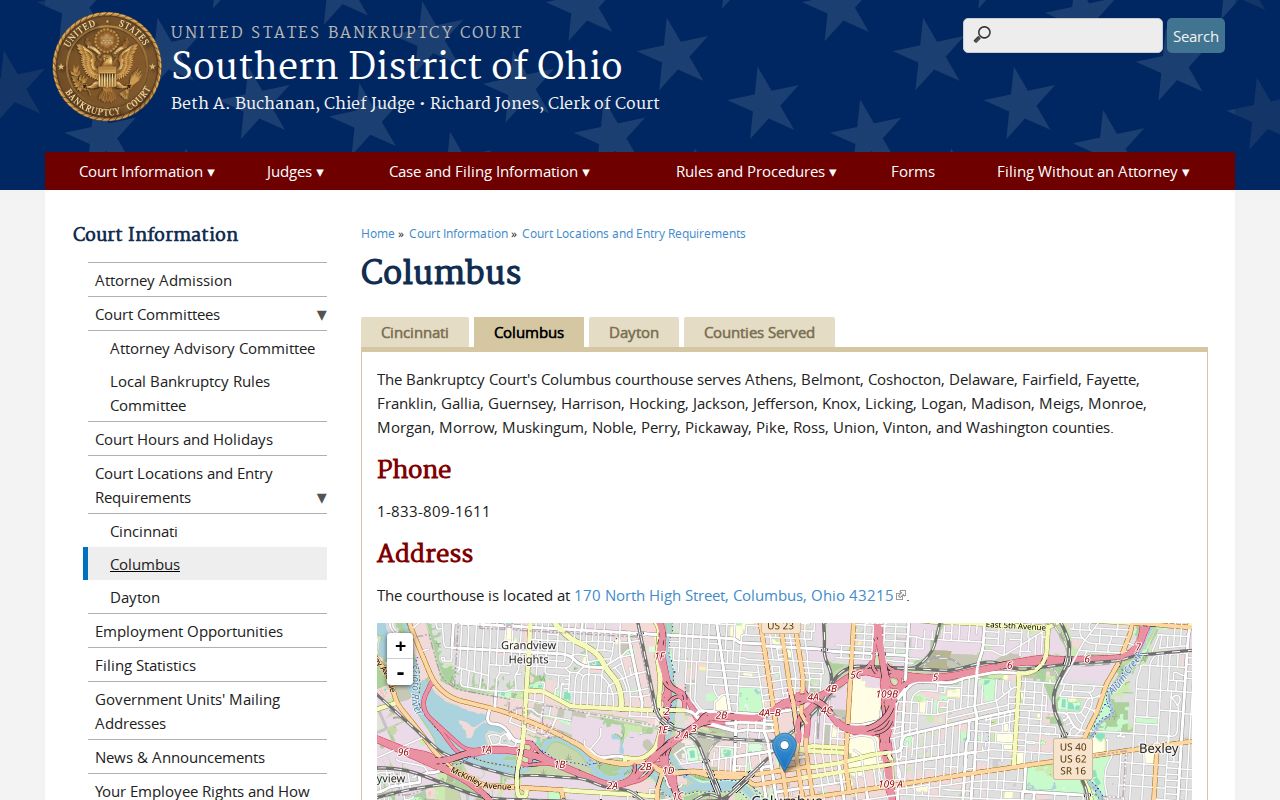
Bankruptcy is the one big exception in Knox County. Those filings live in the federal court system based in Columbus, so a case lookup has to start by picking the right court.